Every Organization Has Complexity Agents. Almost None Has a Simplification Agent.
July 21, 2026
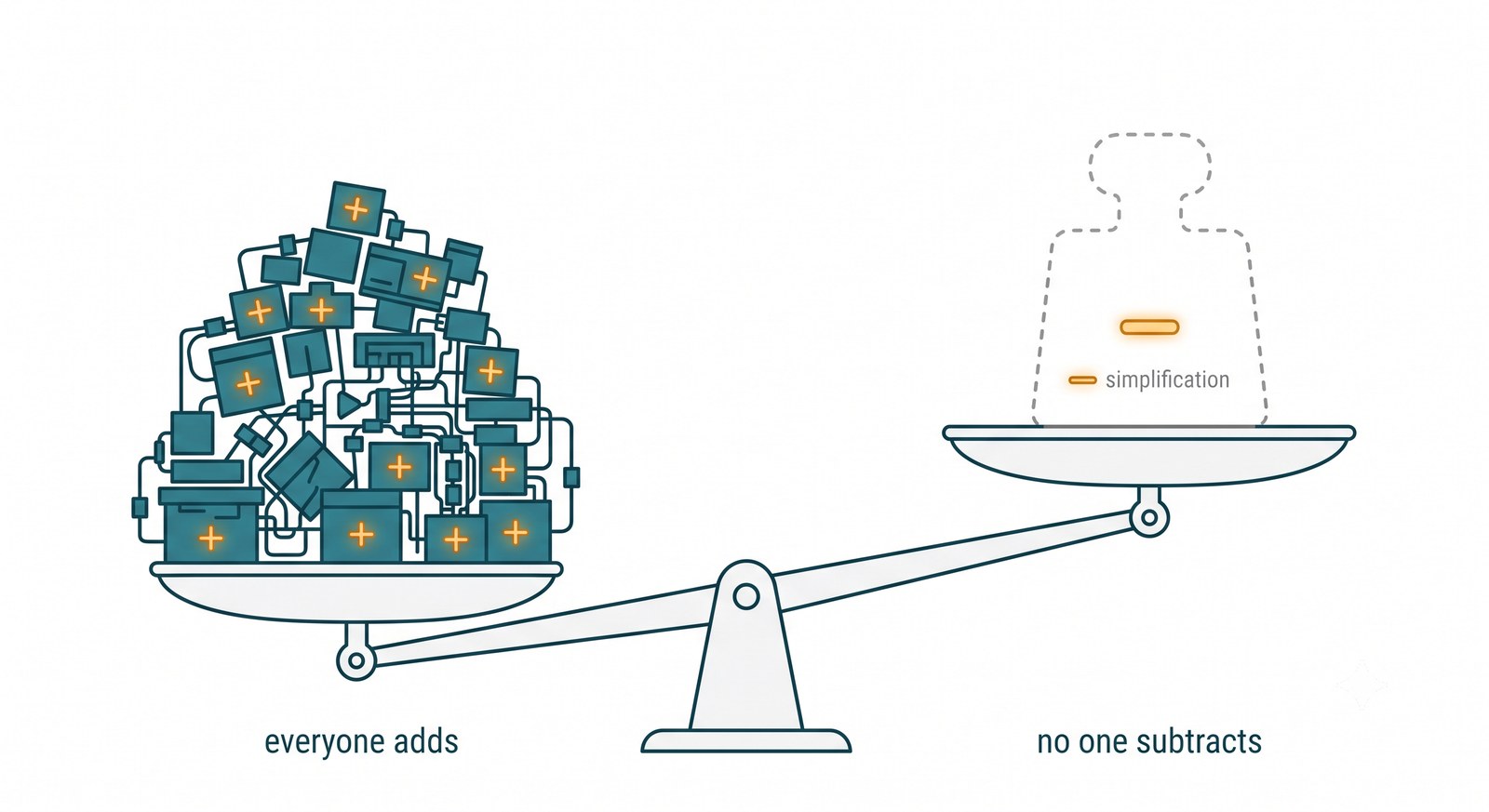
Every organization has complexity agents. Almost none has a simplification agent.
Imagine a business that invents its own rules. The owner loves it when the business runs by the book. It feels like a clean, money-printing assembly line. It feels safe: everything under control.
Sometime in the early 2000s that owner read a book on optimizing business processes — my own favorite on the subject, “Reengineering the Corporation.” Consultants from respectable firms gave a presentation: “you need to build out your processes.” So a dedicated department was created to describe the company’s processes and improve them.
Its people earned bonuses for performance. Write more process descriptions. Write them deeper. Make them exhaustive. Force everyone to follow them. Stand up a supervisory body. Stand up an internal court. Impose fines. They invented a thing they called a driver — a mechanism that makes people follow the process. Then a mechanism to control the process. Then a mechanism to control the controllers.
As the years passed and the company grew, the layer of managers writing processes grew, and above it a layer of controllers policing them. Plenty of people were paid to produce more: more rules, more drivers. They did their job well. And soon it was clear that something was wrong in the kingdom. People said so in the smoking rooms and the hallways, never in the meetings. The boss loved making processes; you didn’t upset him, because he was quick to punish.
Then hard times came, and the organization failed the test. The strength and resources that would have carried it through had already gone — into perfecting processes, coercing staff, adding control.
Joseph Tainter wrote about the same thing in “The Collapse of Complex Societies” (1988): complex societies fall when all their resources go to maintaining the complexity they have already accumulated. It holds for organizations too.
And the cure was so close. To that crowd of complexity agents, add just one agent of simplification — one department, or even one person, whose job is to scan the landscape for chances to simplify. Believe me, they were there.
I’m telling this story because I see the same thing today. AI assistants make code, modules, and whole solutions cheap to produce, so the architect is tempted to build more. The project grows, turns unwieldy, gets expensive to run. I work with large enterprises, and their landscape is a pile-up of exactly these projects. It’s high time to simplify. I build toward autonomous organizations, and they cannot survive without a built-in counterforce of simplification.
How do I do it? In my own project I’ve built a procedure — for now, a simple monthly scan of the landscape: across code, rules, outcomes, and customer-facing surfaces. At several levels it flags chances to simplify, and each becomes a fix.
Does your organization have a simplification agent? Ask who holds the “right to cut.”