Dynamic State Architecture — One Model, Three Dates, Nothing Redrawn
August 5, 2026
I recently saw Gartner’s new term, Dynamic State Architecture — the dynamic adaptation of architecture to strategy. Gartner is already talking about this, but why do most architects still present their work as Current State and Target State?
On 18 May Gartner published the Hype Cycle for EA 2026, where Dynamic State Architecture appears as a profile of its own, flagged as moving fast. That matters: in recent years we have seen plenty of examples of turbulent change in politics, the economy and society — and, unfortunately, plenty of examples of the systems we build going obsolete while we are still building them.
Gartner reads the new term as planning architecture against the situation and the changes in the environment, rather than three years ahead as before. That is excellent — but is there a convenient tool for planning that way? The first thing that comes to mind is an architecture collaboration platform, LeanIX or Ardoq, where documents are kept current by discipline rather than by automation.
In my world architecture is text: a textual description of your business, stored as a digital model of your enterprise. Everything — every unit, system, system of systems, relationship, goal, initiative — is stored as text. And that text changes over time. You can take a slider, a playhead, and move through time, watching your enterprise change. More interesting still: press play, as in a film, and watch the business evolve. After the Current State there are many computed, shifting Transition States, so you can see the enterprise change day by day. The Target State is the same diagram, computed for a future date.
This is not a dream and not a theory. The dynamic approach is built into the methodology itself, and a tool that works this way already exists — DSM. Look at the screenshots: enterprise capabilities appear, mature and retire over time, and the date can be set to any day — the view is regenerated. These are not drawn pictures: they are generated from the textual representation of the model. The data here is constructed; it is not anyone’s real model.
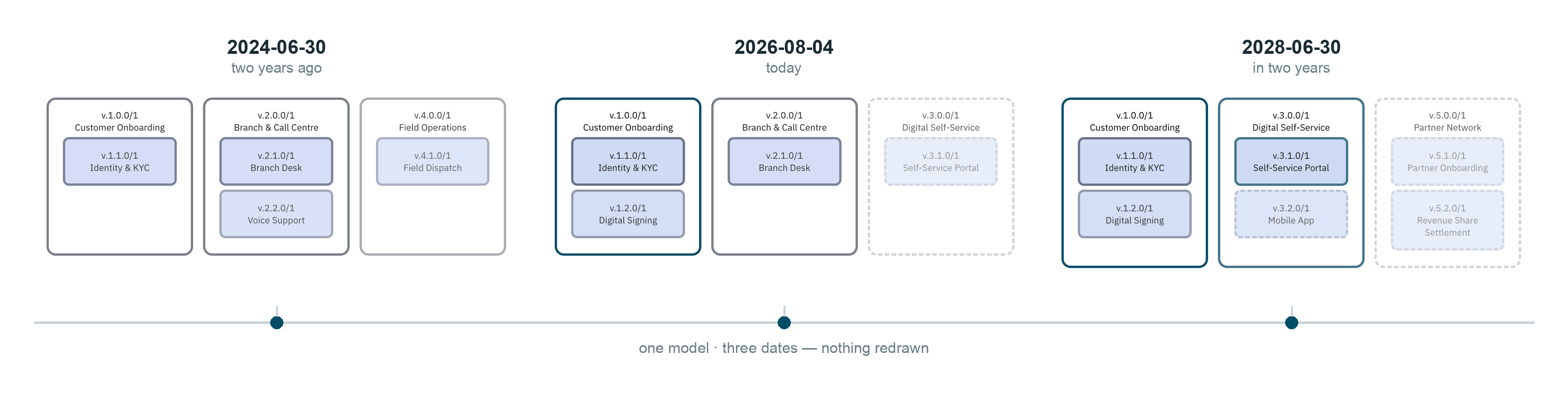
In the same way you will be able to see your whole enterprise landscape changing over time. Picture it: a functional diagram of your landscape on which new systems appear and obsolete ones retire, and new integrations and enterprise capabilities arrive.
And that is not even the most remarkable part: by simply swapping the data, the text, by simply asking an agent, you can change the representation, the view, the concept, the scenario almost in real time. The room for modelling and for presenting it grows a great deal.
And your Target State, your Roadmap — is it a drawn picture, or a projection of a model?